AI networking and session recommendations are everywhere in event tech right now. Here is an honest look at what actually works, where the hype outstrips reality, and what associations should ask before they invest.

Every event tech vendor has an AI story right now. Some of them are true. AI matchmaking, intelligent session recommendations, and automated networking facilitation have genuine potential to improve the attendee experience at professional association conferences. They also have genuine limitations that are rarely discussed in sales conversations.
For association executives and PCOs evaluating event technology, the challenge is separating the features that will make a measurable difference from the ones that sound impressive in a demo and underdeliver at the event. This guide is an attempt to do that honestly.
Here is what AI at events actually looks like in 2026, what works, what does not, and what you should be asking before you sign anything.
What is AI matchmaking at events and how does it work?
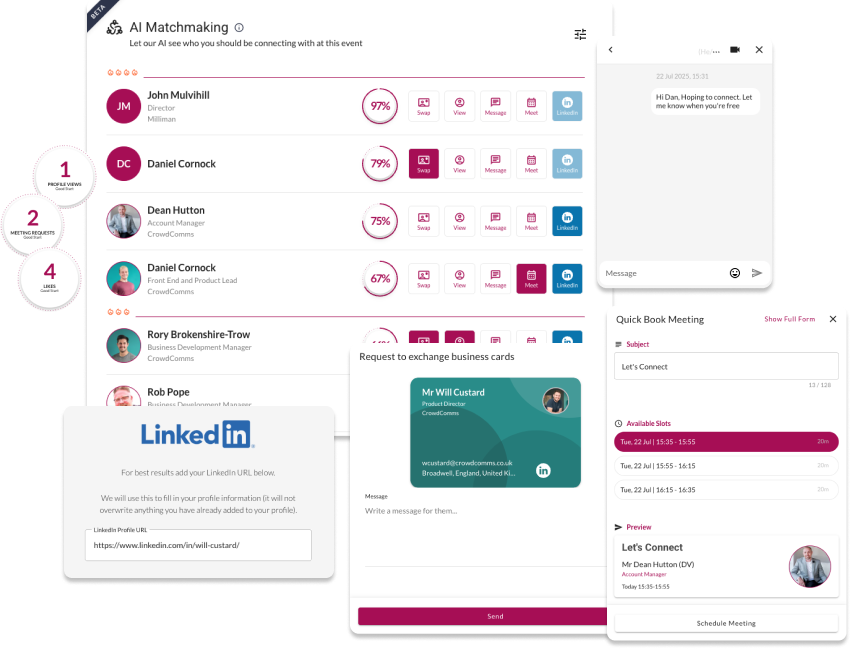
AI matchmaking at events uses algorithms to identify and surface relevant connections between attendees based on profile data, stated interests, and in-app behaviour. The goal is to help attendees find people worth meeting without having to manually browse a full delegate list of several hundred or several thousand names.
In most event apps, this works in three stages. First, the system ingests attendee profile data: job title, organisation, industry, topics of interest, and any structured data collected at registration. Second, the algorithm identifies patterns of similarity or complementarity between attendees based on this data. Third, suggestions are presented to the attendee inside the app, typically as a recommended connections list, with a prompt to send a meeting request or message.
The quality of the output is entirely dependent on the quality of the input. An algorithm working with rich, structured profile data produces relevant suggestions. An algorithm working with sparse profiles, often the case when attendees have rushed through registration, produces suggestions that feel generic or random.
“AI matchmaking is not magic. It is pattern recognition. The patterns it finds are only as useful as the data it has to work with.”
What has AI matchmaking actually delivered at professional events?
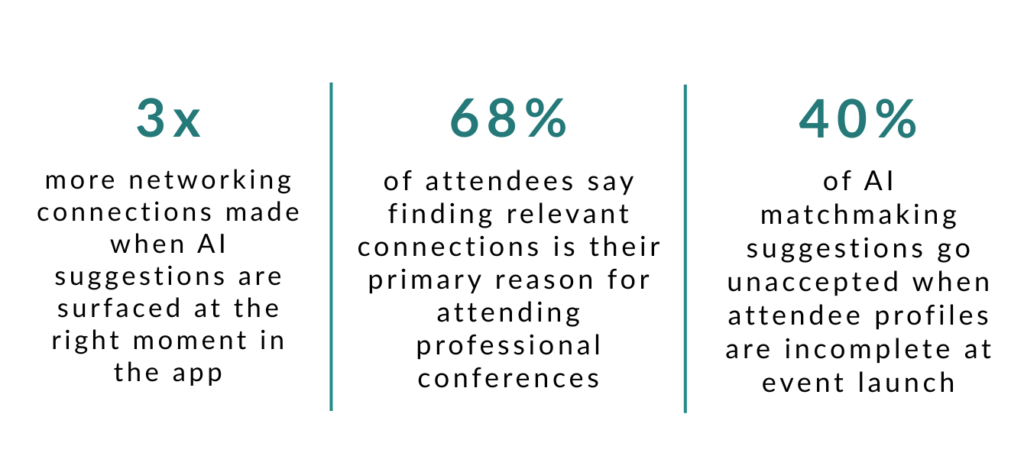
When implemented well, AI matchmaking at association conferences consistently increases the volume and quality of attendee networking connections. The strongest results come from events where attendee profiles are detailed, where the event app is adopted early, and where networking is positioned as a core part of the event experience rather than an optional feature.
Specific outcomes where AI matchmaking has demonstrated clear value:
- Increased meeting volume: Attendees who receive relevant connection suggestions book more meetings than those browsing an unfiltered attendee list. The reduction in search effort directly drives action.
- Better cross-sector connections: AI can surface connections between attendees from different organisations or roles who share specific interests but would never identify each other manually. This is particularly valuable at large association conferences where serendipitous discovery is harder.
- Higher app engagement: Events that integrate AI recommendations into the core app experience, rather than hiding them in a sub-menu, see higher overall app engagement. Relevant suggestions give attendees a reason to return to the app repeatedly.
- Improved networking satisfaction scores: Post-event survey data consistently shows higher networking satisfaction at events using AI matchmaking compared to those using basic attendee directories, provided the implementation is well-executed.
Where does AI networking hype outrun reality?
The gap between AI matchmaking as it is marketed and as it performs in practice is almost always a data problem, not a technology problem. Vendors rarely discuss this in sales cycles, but it is the single most important variable in whether the feature works for your event.
WHERE AI MATCHMAKING FALLS SHORT
- Sparse attendee profiles: When attendees complete minimal profile information at registration, the algorithm has nothing meaningful to work with. Suggestions based on job title alone are rarely relevant enough to prompt action.
- Late profile completion: Matchmaking works best when profiles are complete before the event opens. Attendees who fill in their profile on the morning of day one miss the pre-event recommendation window entirely.
- Poor app placement: AI suggestions buried in a sub-menu do not get seen. If networking recommendations are not surfaced on the home screen or as part of the onboarding flow, adoption is negligible regardless of algorithm quality.
- “AI” that is not AI: Some vendors use the term to describe basic keyword matching or alphabetical filtering with optional tags. Ask specifically how recommendations are generated before assuming the feature is what it claims to be.
- No human fallback: Events that rely entirely on AI matchmaking without providing a browsable attendee directory or opt-in networking tool create a poor experience for attendees whose profiles do not generate useful suggestions.
The honest summary: AI matchmaking is a multiplier, not a foundation. It amplifies the value of good data, a well-designed app experience, and a strong pre-event communication strategy. It does not replace any of those things.
What do AI session recommendations look like when they work?
AI session recommendations work when they help attendees navigate complexity, not when they simply surface popular sessions. At a single-track conference with twelve sessions, a recommendation engine adds little. At a multi-track association conference with sixty sessions across five streams, it can meaningfully improve the attendee experience.
The best implementations of AI session recommendations share three characteristics:
- They are personalised to role and interest, not popularity: A recommended session should appear because it is relevant to this specific attendee, based on their profile and stated objectives. A session that is recommended because it has the most bookings is not an AI recommendation — it is a popularity chart.
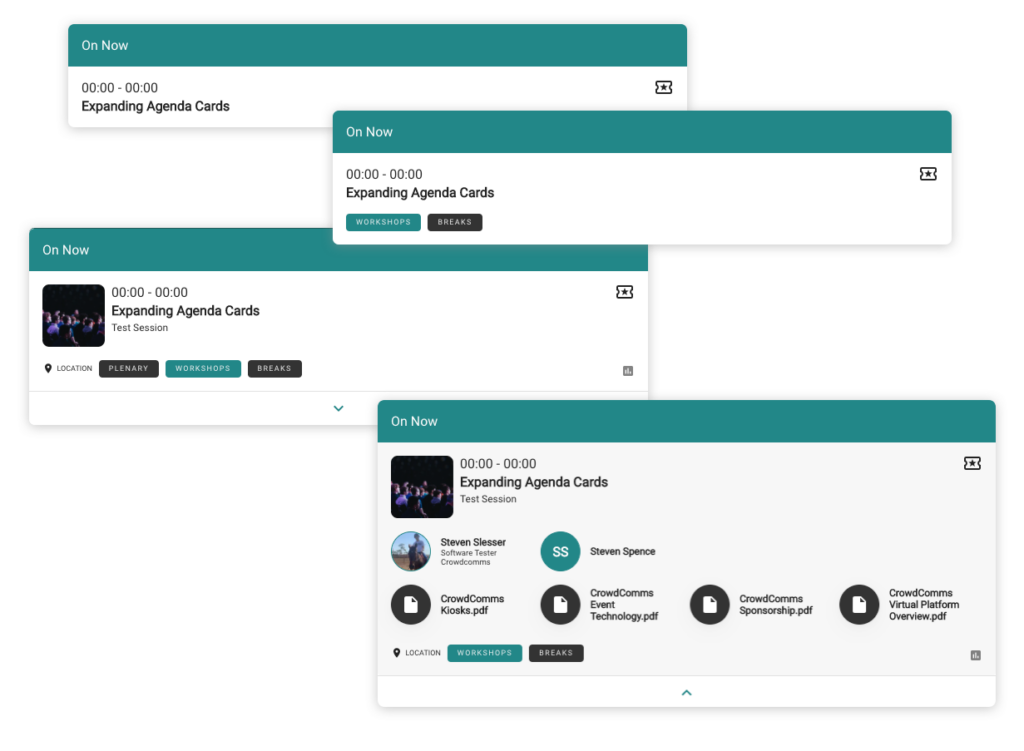
- They are surfaced at the point of agenda-building: Recommendations shown while an attendee is actively constructing their schedule are acted on. Recommendations shown on a separate page that requires navigation are largely ignored.
- They adapt to behaviour during the event: An attendee who attends three sessions in the data analytics track should start seeing more recommendations from that track. Static recommendations based on registration data alone do not improve over the course of a multi-day event.
“The test of a good session recommendation is simple: does the attendee think it was suggested for them specifically, or does it feel like a generic popular picks list?”
What should associations look for in AI networking tools?
The most important thing to evaluate in any AI networking tool is not the algorithm — it is the data infrastructure that feeds it. A vendor who cannot clearly explain what data powers their recommendations and what a minimum viable profile looks like should be treated with caution.
Beyond data quality, look for:
- Profile completion prompts: Does the platform actively encourage attendees to complete their profiles before the event? Pre-event email reminders, in-app nudges, and a visible profile completion indicator all drive the data quality that makes matchmaking work.
- Recommendation surfacing: Where in the app do suggestions appear? Home screen integration and onboarding flow placement outperform sub-menu placement in every implementation.
- Meeting booking integration: Can attendees act on a recommendation in one step, by sending a meeting request or a message directly from the suggestion? Any additional navigation between seeing a suggestion and acting on it reduces conversion.
- A directory fallback: Is there a searchable, filterable attendee directory for attendees who prefer to find connections manually? AI should augment human choice, not replace it.
- Post-event reporting on networking: Can you see which AI suggestions led to meetings, and how many of those meetings were rated positively in post-event surveys? Without this data, you cannot improve the feature for the next edition.
How do you measure whether AI matchmaking is working at your event?
The primary metric for AI matchmaking success is connection acceptance rate: the percentage of AI-suggested connections that attendees act on by sending a message or a meeting request. A secondary metric is meeting completion rate — the percentage of meeting requests that result in a confirmed meeting taking place.
Benchmarks to aim for:
- Connection acceptance rate above 30%: Below this threshold, suggestions are likely too generic. Review profile data completeness and algorithm settings.
- Meeting completion rate above 60%: Meetings that are requested but not confirmed often indicate a friction problem in the meeting booking flow rather than a matchmaking problem.
- Post-event networking satisfaction score above 7/10: Collected via the event survey, this provides qualitative context for the quantitative metrics.
Compare these metrics to your previous event’s networking data, and to any events where you used a basic attendee directory without AI recommendations. The difference in outcome tells you whether the AI feature is earning its place in your technology stack.

What questions should you ask your event tech vendor about AI features?
The right questions to ask about AI event features are about data, evidence, and measurement, not about the technology itself. Any vendor can demonstrate an impressive-looking recommendation interface. Fewer can show you outcome data from real events.
QUESTIONS TO ASK YOUR VENDOR
- What data does the algorithm use? Specifically: which registration fields are required, which are optional, and what is the minimum profile data needed for a useful suggestion?
- What does a good connection acceptance rate look like on your platform? If they cannot give you a benchmark from real events, that is a red flag.
- Can we see examples of the recommendation experience from a recent event of similar size and type? A live demo using dummy data is not evidence of real-world performance.
- What happens to attendee data used to train or improve the algorithm? Data governance is a serious concern for associations with members in regulated industries.
- What support do you provide for profile completion before the event? Tools without a pre-event profile strategy rarely deliver on the promise of the AI feature.
- How do you report on networking outcomes after the event? Post-event analytics on matchmaking performance should be part of the standard reporting package, not a premium add-on.
How does CrowdComms approach AI at events?
CrowdComms builds AI features around the principle that technology should produce outcomes attendees notice, not features that appear in product screenshots. That means being clear about what our AI tools do and do not do, and ensuring the data infrastructure is in place before the algorithm runs.
In practice, that means:
- Profile-first onboarding: Our pre-event communication framework drives attendee profile completion before the event opens, so the matchmaking algorithm has quality data to work with from day one.
- Home screen recommendation placement: AI suggestions appear where attendees are already looking, not in a separate networking section that requires navigation to find.
- One-step connection actions: Attendees can send a message or meeting request directly from a recommendation with a single tap. No additional steps between seeing a suggestion and acting on it.
- Transparent post-event reporting: Connection acceptance rates, meeting volumes, and networking satisfaction data are included in every post-event analytics pack. If the AI feature is working, the data will show it. If it is not, you will know why.
- A browsable attendee directory alongside AI: We do not force every attendee through an AI funnel. A searchable, filterable directory remains available as a complement to AI suggestions, because good networking tools should serve every type of attendee.
AI event technology checklist for associations
Use this before evaluating or deploying AI matchmaking at your next conference.
AI MATCHMAKING READINESS CHECKLIST
- Have you identified which registration fields will power the matchmaking algorithm, and are they structured (not free text)?
- Is there a pre-event campaign to drive attendee profile completion at least two weeks before the event opens?
- Are AI networking suggestions surfaced on the app home screen or within the onboarding flow, not only in a sub-menu?
- Can attendees send a meeting request or message in one step directly from a recommendation?
- Is a searchable attendee directory available as a fallback alongside AI recommendations?
- Have you asked your vendor for connection acceptance rate benchmarks from comparable events?
- Have you confirmed your vendor’s data governance policy for attendee data used by the AI?
- Is post-event reporting on networking outcomes included in your platform contract, not a premium add-on?
Talk to the team
Frequently Asked Questions
A mobile event app is a mobile or web-based application that supports event attendees with agendas, engagement tools, content, notifications and interaction.
The best event app depends on your goals. For engagement-led events, specialist mobile event apps often outperform all-in-one platforms.
Attendees use event apps that are intuitive, interactive and relevant to their experience. Are event apps dead? Definitely not. Read or watch our 2025 Event Advice on event apps.
Yes, modern event platforms support in-person, hybrid and virtual attendees through mobile and web-based access.
Related Articles:
Event attendance tracking has rapidly evolved from a simple headcount to one of the most