
Article

Table of Contents

The real value of event technology

Share post:

Event tech gets thrown around like it’s the answer to everything.
 
Better engagement. Better data. Better experiences. Better ROI. But if you strip all that back for a second… what’s it actually doing for the people inside an organisation? Because that’s where the real story is.
 
In our latest Event Advice conversation with Ryan Hamill (Head of Enterprise Sales at CrowdComms), we got into exactly that — not the shiny features, but the actual, practical value of event technology across a modern events team.
 
And what came out of it wasn’t a pitch for software. It was a reality check on how complex, pressured, and frankly impressive the events industry has become.

Event technology isn’t one thing.

It’s different value for different people.
 
One of the biggest mistakes people make when talking about event technology is assuming it delivers the same value to everyone.
 
It doesn’t.
 
Inside a typical global organisation, you’re looking at layers of people all interacting with events in completely different ways:
    • CMOs and senior leadership
    • Global heads of events
    • Regional event leads
    • Event managers and planners
    • Field marketers and support teams

Each of them needs something different from event tech.

 
And if your platform only solves one of those problems, it’s not really solving the bigger picture.

For CMOs: Event Tech Finally Brings Clarity to ROI

Let’s start at the top.
 
The CMO role is brutal.
 
They’re responsible for huge budgets, often with events taking up a significant chunk of total marketing spend. But unlike sales, where success is obvious, marketing — and especially events — has always struggled with proving impact.
 
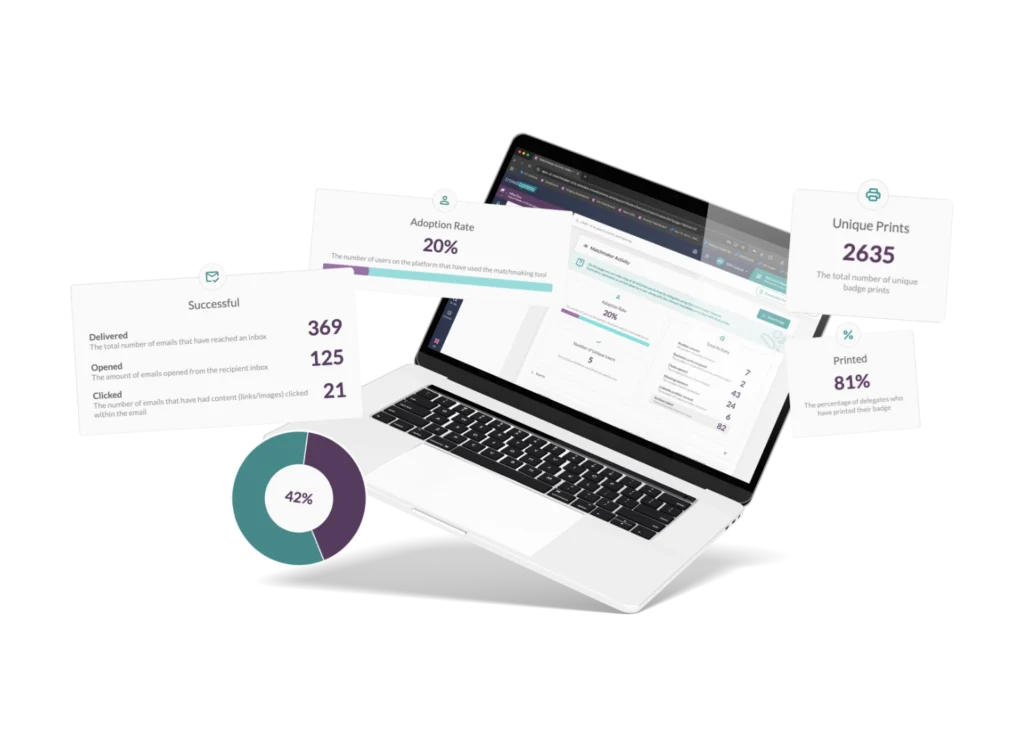
This is where event technology changes the game. Done properly, it gives CMOs a single view of their entire event ecosystem:
    • Where attendees are coming from
    • Which events are performing best
    • Engagement levels across sessions
    • Lead generation and conversion
    • Net promoter scores and sentiment
    • Revenue influenced by events
 That’s not just useful — it’s essential.
 
Because when someone in the boardroom asks, “What are we actually getting from our events?” — you need more than a gut feeling. You need answers.
Data & Analytics montage

For event leaders: control, consistency, and a lot of pressure

Now step down a level to the global head of events. This is where things get complicated.
 
They’re not just thinking about one event. They’re managing entire event programmes across regions, brands, and teams — all with different expectations, suppliers, and ways of working. Their world looks something like this:
    • Multiple countries and time zones
    • Different languages and audiences
    • Regional customisation vs global consistency
    • Complex supplier relationships
    • Tight budgets and even tighter timelines
Event technology helps bring structure to that chaos. But here’s the nuance…
 
It’s not necessarily making their day-to-day easier. Instead, it gives them oversight.
 
It gives them the ability to standardise processes, maintain brand consistency, and report upwards with confidence. And in a world where decisions are increasingly data-led, that visibility is everything.

For event planners: This is where tech should make the biggest difference

If there’s one group that should feel the full benefit of event technology, it’s the people actually delivering the events.
 
The planners. The marketers. The people on the ground.
 
These are the ones juggling:
    • Multiple events at once
    • Tight deadlines
    • Stakeholder demands
    • Registration, comms, logistics, content
    • Last-minute changes (always)
 And the scale is wild.
 
We’re talking about small teams delivering hundreds of events a year.
 
That’s not normal in most industries. That’s elite-level output. So when we talk about event tech, this is the real test: Does it make their lives easier?
 
Because if it doesn’t — if it adds friction instead of removing it — then it’s missing the point entirely.

The shift to data-driven events (and what we might be losing)

One of the most interesting parts of the conversation was around how data-driven the events industry has become. Everything is tracked now. Dwell time. Session attendance. Engagement rates. Meetings booked. Leads generated.
 
And while that’s powerful, it raises a question… What about the feeling?
 
The energy in the room. The buzz. The moments that actually make events memorable. Because those things are harder to measure.
 
You can approximate them with metrics. You can infer them through behaviour. But you can’t fully capture them.
 
And that tension, between data and experience, is something every events team is now navigating.

Choosing the right event tech partner in 2026

Looking ahead, one thing is clear. The events landscape isn’t getting simpler. It’s getting more unpredictable.
 
Global uncertainty, shifting markets, changing attendee expectations — all of it adds pressure to event programmes. Which means the choice of event technology matters more than ever. Not just in terms of features. But in terms of flexibility.
 
If plans change, can your tech adapt? If locations shift, can your platform support it?
 
If you need to pivot from in-person to hybrid or digital, are you covered?
 
And maybe most importantly…
 
Do you actually trust the people behind the platform? Because in reality, you’re not just buying software.
 
You’re choosing a partner.

Final thought: Event professionals deserve better tools

There’s one thing that came through loud and clear.
 
Event professionals are operating at a level most industries wouldn’t believe. Small teams. Huge workloads. High expectations. And they just get on with it.
 
So if event technology is going to play a role in the future of this industry, it needs to step up. Not with more noise. Not with more complexity. But with tools that genuinely support the people doing the work.
 
Because when you get that right, everything else — the data, the ROI, the experience — starts to fall into place.
 

Watch the full episode

If you want to go deeper into the conversation around event tech, ROI, and the realities of running modern event programmes, watch the full episode of Event Advice here.

Frequently Asked Questions

What is a mobile event app?

A mobile event app is a mobile or web-based application that supports event attendees with agendas, engagement tools, content, notifications and interaction.

What is the best event app in 2026?

The best event app depends on your goals. For engagement-led events, specialist mobile event apps often outperform all-in-one platforms.

Do attendees actually use event apps?

Attendees use event apps that are intuitive, interactive and relevant to their experience. Are event apps dead? Definitely not. Read or watch our 2025 Event Advice on event apps.

Are event apps suitable for hybrid and virtual events?
 

Yes, modern event platforms support in-person, hybrid and virtual attendees through mobile and web-based access.

Related Articles:
Get Advice on your event app

Planning your next event?

Get in touch

Whatever your vision for your next virtual, hybrid or in-person event, we can help.