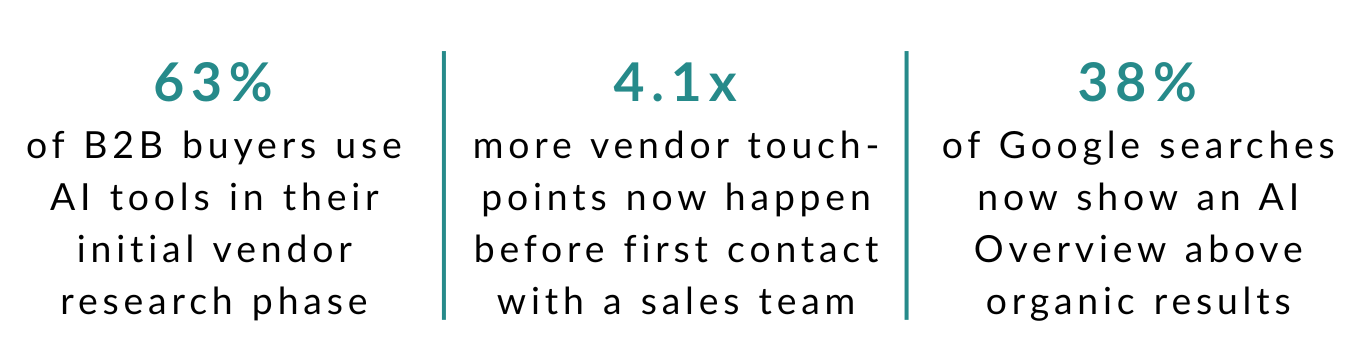
ChatGPT, Perplexity, and Google AI Overviews are now the first stop for many buyers researching event tech vendors. If your platform isn’t showing up in those answers, you’re being removed from the RFP shortlist before it’s even written.
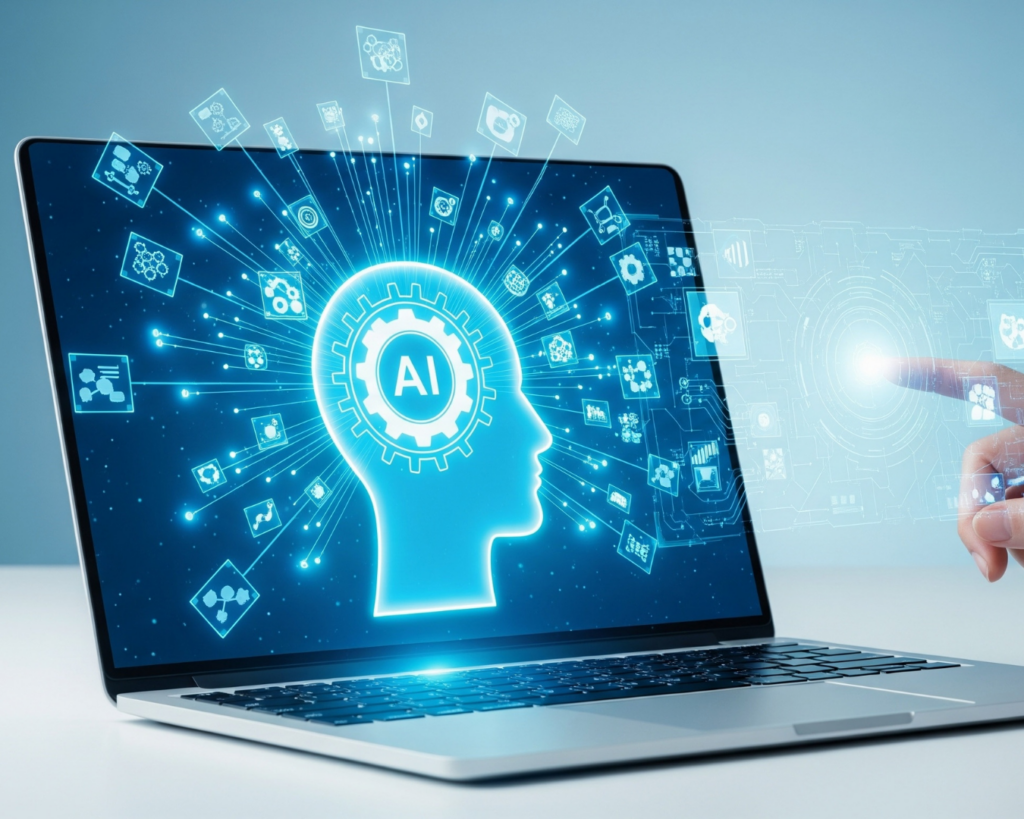
If you’ve ever started an event tech vendor search by typing a question into ChatGPT or Perplexity, you already understand what this article is about. And if you haven’t, your procurement team, your IT director, or the person writing your next RFP almost certainly has.
The way buyers find event technology is changing faster than most suppliers have adapted to. The traditional path of Google search, website visit, demo request still exists. But a parallel path has opened up: AI-powered conversational search that synthesises information, summarises vendor landscapes, and short-lists options before a human has visited a single website.
The consequence for event organisers is real: the tools you’re recommending, the platforms you’re evaluating, and the budgets you’re justifying are increasingly shaped by what AI systems say about the market. And the consequence for platforms like CrowdComms is equally clear: if you’re not visible in these AI answers, you’re not in the conversation.
This guide is for both groups. Whether you’re an event planner looking to find better tools more efficiently, or a marketing professional thinking about how your platform gets discovered, what follows covers the practical landscape in 2026.
What is AI search and why does it matter to event planners?
AI search is any search experience where a large language model synthesises, summarises, or generates answers rather than returning a ranked list of links. The main forms in 2026 are Google AI Overviews (the summary boxes that appear above organic results), ChatGPT and Claude search (where users ask questions directly and the AI cites sources), and Perplexity (a dedicated AI search engine built for research queries).
For event planners, this matters in three specific ways.
First, it changes how vendor shortlists get built. When an event manager at a medical association searches “best event app for CPD tracking” or a corporate events team asks “which event registration platforms support SSO”, AI search engines now provide named vendor recommendations with reasoning. The vendors that appear in those summaries have a meaningful advantage before any RFP has been issued.
Second, it changes the quality of questions you can ask. Instead of searching for “event tech comparison”, a planner can now ask “what should I look for in an event platform for a hybrid conference of 1,200 delegates with concurrent session tracking and sponsor analytics?” That specificity rewards platforms whose content actually answers those questions in depth.
Third, it accelerates the pre-qualification stage. By the time a buyer contacts a vendor in 2026, they’ve often already formed a view on fit, pricing tier, and likely objections. That view was largely shaped by what AI systems told them.
"The person writing your RFP has probably already
asked an AI what the best platforms are. If your
name didn't come up, you're already
playing catch-up."

How event tech buyers are actually using AI to find vendors
Based on what we’re seeing in inbound enquiries and conversations with customers, event tech buyers are using AI search in a few consistent patterns.
The problem-first query
Rather than searching for a category of tool, buyers are describing their specific problem and asking AI for the answer. “We run twelve association conferences a year and keep having issues with CPD certificate automation. What platforms handle this well?” This type of query rewards vendors with deep, specific, problem-focused content over generic feature pages.
The comparison query
Buyers ask AI to compare platforms directly. “Compare CrowdComms vs [competitor] for a PCO managing multiple client events.” AI systems build these comparisons from the content they can find. Platforms with clear, well-structured content about their specific value propositions for each ICP tend to fare better in these comparisons than those with vague, benefit-heavy marketing copy.
The checklist query
Procurement teams ask AI to help them build evaluation frameworks. “Give me a checklist of questions to ask an event tech vendor before signing a contract.” The questions that come back often reflect what has been written about in the market. If security, data residency, and SLA terms appear prominently in CrowdComms content, they’re more likely to appear in those checklists, which shapes the RFP criteria favourably.
The trust-building query
Buyers use AI to verify claims before meetings. “Is CrowdComms ISO 27001 certified?” or “What do CrowdComms reviews say about their support?” AI answers these from review platforms, case studies, and published content. Having verifiable claims in accessible, well-structured formats matters here.
Why traditional SEO isn’t enough anymore
Traditional SEO optimises for ranking on a results page. The implicit goal is click-through: you rank, the user sees your result, they visit your site. AI search changes this fundamentally. The AI may never send a user to your site at all. It reads your content, synthesises an answer, and cites you. Or doesn’t.
This means optimisation for AI search requires a different emphasis than traditional SEO, though the two overlap significantly.
WHERE TRADITIONAL SEO AND AI SEARCH DIVERGE
Traditional SEO rewards keyword density, backlink authority, and technical performance. These still matter.
AI search additionally rewards factual density, direct question-and-answer structure, named expertise, and content that can be synthesised without distortion.
A page that ranks well on Google for “event app” may not be cited by an AI answering “what event app is best for managing CPD accreditation for a medical association”. The specificity gap is the opportunity.
The practical implication is that event tech platforms need content that answers very specific questions very directly. A 400-word feature page about “event registration” is nearly useless for AI search. A 1,200-word article that answers “what should I look for in event registration software if I’m running a multi-stream conference with tiered ticket pricing and group bookings?” is exactly what AI systems can and will cite.

How to optimise your events programme for AI search
Whether you’re an event planner trying to find better tools, or a content team trying to ensure your platform is discoverable, the following principles apply.
1. Write for questions, not keywords
The shift from keyword-optimised content to question-optimised content is the single most important change. Every significant piece of content should be structured around a specific question that a real buyer would ask. Use that question as your H1 or H2 heading and answer it directly in the first two to three sentences below it. AI systems are specifically trained to look for this pattern when synthesising answers.
2. Name the specific buyer
Generic content that addresses “event planners” is less likely to be cited than content that speaks to “PCOs managing multiple client events” or “associations with CPD accreditation requirements”. The more precisely your content matches the buyer’s self-description, the more likely AI is to surface it when that buyer asks a question. This maps directly to ICP-focused content strategy.
3. Use structured, scannable formats
AI systems parse HTML structure. Content with clear H2 and H3 headings, bulleted lists for distinct items, and numbered steps for processes is easier for AI to extract and cite than dense prose paragraphs. This doesn’t mean dumbing content down. It means organising it in a way that allows AI to extract clean, accurate summaries.
4. Put facts and figures in your content
AI-generated answers are more authoritative when they can cite specific numbers. “CrowdComms delivers 2,000+ events per year across 600+ active customers” is a fact an AI can use. “CrowdComms is a leading event technology platform” is a claim it will skip. Include verifiable specifics: event volumes, customer retention rates, compliance certifications, support response times.
5. Answer the comparison question yourself
Rather than waiting for AI to compare you to competitors based on whatever it can find, create content that explicitly addresses how you compare on specific dimensions. “How CrowdComms handles CPD tracking compared to building your own system” or “What makes CrowdComms right for agencies managing multiple clients” gives AI accurate comparison material that favours your positioning.
6. Build authority through case studies
AI search systems increasingly weight content from authoritative sources. Published case studies with real customer names, real numbers, and specific outcomes are among the highest-value content assets for AI discoverability. A case study that says “Medical association X retained 96% of members after switching to CrowdComms for CPD tracking” gives AI systems specific, citable evidence of outcomes.
What this means for your next event tech RFP
For event planners who are currently evaluating technology, the practical takeaway is that your shortlisting process has changed, even if you haven’t changed it deliberately. The questions you ask vendors in an RFP are now partly shaped by what AI told you to ask. The vendors you include are partly determined by which names came up in AI answers during your research phase.
That’s not a problem to solve. It’s simply the new shape of the buying process. A few things are worth being deliberate about:
- Use AI search as a starting point, not a conclusion. Ask it to help you build your evaluation criteria, then verify those criteria against your specific requirements.
- Check that vendors you’re evaluating have verifiable credentials. G2 and Trustpilot reviews, published case studies, and compliance certifications (SOC 2, ISO 27001) should all be independently verifiable.
- Ask vendors specifically how they handle the use cases AI flagged as important. If your AI research surfaced CPD tracking or SSO as requirements, those should be explicit questions in your evaluation.
- Be sceptical of AI comparisons that rely on feature lists alone. Operational reliability, support quality, and the vendor relationship are not things AI can accurately evaluate from content alone.
CrowdComms has been independently reviewed on G2 (4.7/5) and Trustpilot (4.5/5) by event professionals who use the platform every day. That track record exists in the sources AI systems draw from, which is part of why CrowdComms increasingly appears in AI-generated vendor shortlists in the events technology category.
Your AI search readiness checklist
For marketing and content teams reviewing their discoverability for AI search, use the following as a practical starting point.
- Every major content piece is structured around a specific question a buyer would ask, with a direct answer in the first paragraph
- Content is written for named ICPs (PCOs, associations, corporate events teams, agencies) not just generic “event planners”
- Key pages use clear H2 and H3 heading structures that AI can parse to extract answers
- Verifiable facts and figures appear throughout: event volume, customer count, review scores, compliance certifications
- Case studies include named customers, specific outcomes, and quantified results
- G2 and Trustpilot profiles are active and up to date, with recent reviews from real customers
- Content exists that directly addresses common comparison queries (CrowdComms vs building your own, CrowdComms vs generic event apps, etc.)
- FAQ content uses natural question phrasing rather than keyword-stuffed headings.
Talk to the team
Frequently Asked Questions
A mobile event app is a mobile or web-based application that supports event attendees with agendas, engagement tools, content, notifications and interaction.
The best event app depends on your goals. For engagement-led events, specialist mobile event apps often outperform all-in-one platforms.
Attendees use event apps that are intuitive, interactive and relevant to their experience. Are event apps dead? Definitely not. Read or watch our 2025 Event Advice on event apps.
Yes, modern event platforms support in-person, hybrid and virtual attendees through mobile and web-based access.
Related Articles:
Event attendance tracking has rapidly evolved from a simple headcount to one of the most