‹ All articles
Event Attendance Tracking: How Smarter Data Creates More Successful Events
This is an archived article. For our latest thinking, see News & Articles and Event Advice.
 Whether you’re running a large conference, an association meeting, or a multi-day exhibition, the ability to track attendees, analyse their behaviour, and understand how they move through your programme is now essential for overall event success. But here’s the truth: counting people is easy. Understanding people is harder, and far more valuable. In this article, we explore how attendance tracking, session behaviour analytics, and unified event registration systems work together to help organisers design better experiences, prove ROI, and make confident decisions for improving future events.
Why Event Attendance Tracking Matters in Events
Events today are built on data. Registration data, session check-ins, engagement tracking, dwell time, expo movement, feedback scores, every piece helps organisers understand what actually happened versus what they think happened. But the real shift is this: Attendance tracking has moved from counting bodies to measuring impact. Knowing that 300 attendees walked into a room means very little without understanding:- How long they stayed
- What they engaged with
- Which speakers held attention
- Whether the session sparked meaningful action
- How it contributed to the attendee journey as a whole

Track Attendance Through an Integrated Event Registration System
A fragmented toolset leads to fragmented insight. When registration, check-in, badging, attendance tracking, and engagement reporting all happen in separate systems, you lose the ability to truly analyse data in a way that drives actionable understanding. Integrated platforms, like CrowdComms, give organisers the ability to:- See the full attendee journey from registration to session exit
- Connect check-in behaviour with session preferences
- Understand how marketing affects turnout
- Track breakout rooms, keynote theatres, and expo areas consistently
- Produce reporting that sponsors actually value
Why Headcounts Don’t Define a Successful Event
A busy room looks great in photos. It reassures stakeholders. It validates a topic. But popularity is not the same as value. A conference session that pulls 150 people but suffers early walkouts or low engagement is not a successful session. By contrast, a smaller breakout with high dwell time and rich audience participation may have delivered far more meaningful impact, and far better sponsor ROI. So the question becomes: How do you define success?With headcount alone? Or with attendee data that shows what really happened?Metrics such as engagement level, session ratings, sentiment, and dwell time paint a more accurate picture of impact.In-Person vs. Virtual Event Attendance Tracking
The contrast is stark.Virtual events:
- Every click is trackable
- Watch time is exact
- Engagement actions are timestamped
- AI can interpret tone and sentiment
In-person events:
- People wander
- Disruptions occur
- Rooms vary in size and acoustics
- Human behaviour is unpredictable
- Badge scanning
- QR codes
- RFID and Bluetooth beacons
- Custom event apps
- Real-time attendance tracking dashboards
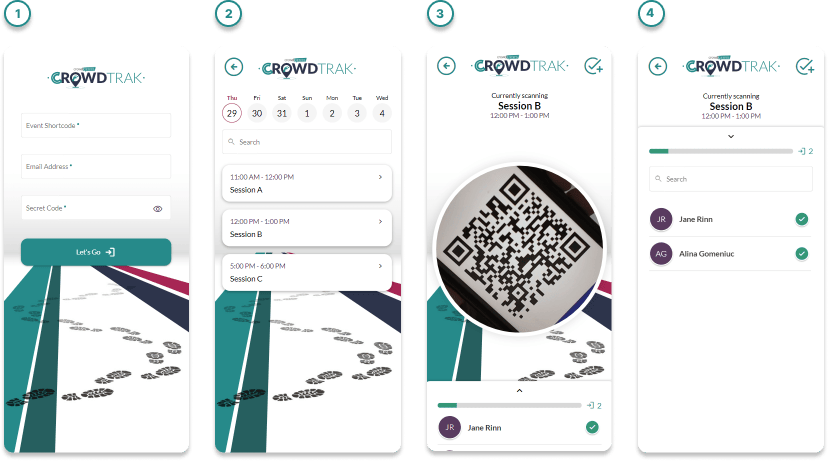
Gamification, CPD & the Simplicity of Voluntary Check-Ins
Not every event needs advanced hardware or facial recognition. For many conferences, the most reliable tracking method is also the simplest: self-check-in via QR codes or CPD scans. Why it works:- Low cost
- Easy setup
- Attendees understand it
- Incentivised tracking (e.g., CPD, points, rewards)
- Works well for session-level reporting
Facial Recognition: Innovation vs. Reality
Debated in our recent Event Advice video (link to video page), facial recognition is one of the most discussed trends in event tech, but also one of the most polarising. The benefits are compelling:- Fast frictionless check-in
- Automated session tracking
- Accurate attendee identity verification
- High equipment cost
- Lighting and camera limitations
- GDPR and privacy concerns
- Attendee unease
- Mixed accuracy depending on demographics
Why Dwell Time is a Secret Weapon for Sponsors
Sponsors don’t just want footfall. They want attention. Dwell time, how long attendees spend in a session or at a stand, is one of the most impactful metrics for proving sponsor value. If 300 attendees walk past a booth but only 12 stop for a genuine conversation, the sponsor might feel frustrated. But if 40 people spend 8+ minutes actively engaged, that’s powerful evidence of ROI. When combined with:- Qualified lead capture
- Session attendance
- Behavioural triggers

Sentiment & Behaviour: The Next Frontier of Attendee Insight
As event tech evolves, organisers are pushing past simple attendance metrics toward deeper measures of quality. We are entering a stage where sentiment analysis helps organisers understand:- Are attendees engaged or bored?
- Are speakers connecting with the room?
- Is the mood positive, neutral, or confused?
- Do questions reflect curiosity or frustration?
How Attendance Tracking Helps You Improve Future Events
All of this, registration → check-in → tracking → engagement → feedback, is ultimately about one thing: Understanding your audience well enough to design even better events next time. Smart attendance tracking helps you:- Build stronger, more relevant content
- Schedule sessions more intelligently
- Balance room sizes and capacities
- Elevate speaker selection
- Improve exhibitor layout and footfall flow
- Justify investment to stakeholders
- Demonstrate ROI to sponsors
- Identify which parts of the conference mattered most
Data Supports Events, It Doesn’t Replace Human Insight
The industry is shifting toward smarter, more integrated event attendance tracking, but great events will always be human at their core.Data tells you:- Where attendees went
- How long they stayed
- What captured their attention
Built For Every Type Of Event.
Designed For Every Kind Of Event Planner.